Freshweek pairs a flexible meal choice with high-volume food production. We connected customer demand to recipes, planning, purchasing, inventory, production, packing and final order assembly, all the way to the customer's door.
a large range of dishes, variants and calorie levels
B2C
thousands of individual delivery points
door to door
process scope: from the customer’s tap to the delivery
INVO's role
From a process mapto a connected system
01
Mapping the operation
We traced the path of an order from the customer's decision to the delivery at their door.
02
Designing the target data flow
We designed how demand, recipes, the plan, inventory and logistics connect to each other.
03
Building and fitting the system
We built every module and fitted it to the way Freshweek actually works.
We are not saying “we rolled out WMS, MES, Purchasing and Packing.” We are showing the path: a customer places an order, Freshweek turns thousands of individual decisions into one workable production schedule, and we connect that process digitally from demand through to the final delivery.
Client context
B2C meal-plan deliverybuilt on deep personalization
Freshweek runs B2C meal-plan delivery. Unlike a plant that makes one or a few products, it has to handle a large range of different dishes, variants, calorie levels and individual customer configurations every day.
Customers either pick their own meals or follow a ready-made plan and the recommendations of an assistant. Every order is at the same time an instruction to the whole operation. Our system has to know what the customer ordered, for which day, in which variant, how much has to be produced, which ingredients that takes, when production has to start, how the meals are packed, which bag they belong to, and where and when the order is delivered.
Project objectives
Connect customer demand to production demand
Create one source of recipe and food-technology data
Forecast demand more accurately before the order cut-off
Tie purchasing and inventory to the production plan
Run production, portioning and packing digitally
Give every product and lot full traceability
Assemble individual customer orders in a digital process
Connect the bag to the customer, the route and the delivery
Close the loop: actuals return to planning
Method
The same five-step patternin every zone
We walk through every zone of the facility in the same sequence: from the operating context to the single biggest change that connecting the process delivered.
01
Context
What this stage looks like in Freshweek's daily work.
02
Problem
What drifts out of line when the stage is not connected to the rest of the process.
03
Analysis and mapping
How we reproduced the way the process actually runs.
04
What we built
How we support this specific part of the operation with our system.
05
The key change
What actually changes in the operation once the data is connected.
Facility zones
The Freshweek plantas a single operation
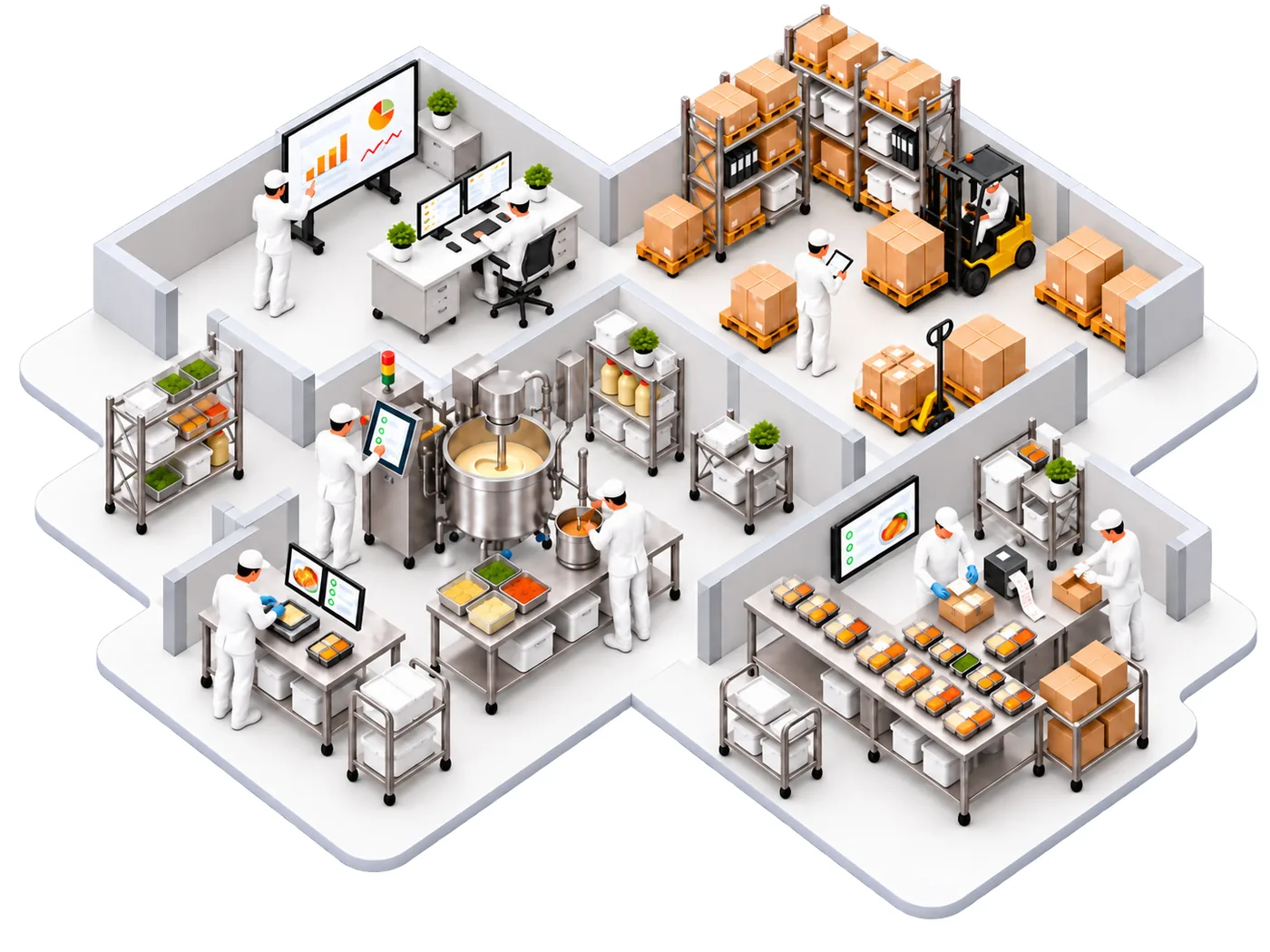
We invite you on a visual walk through the Freshweek plant. Rather than describe our system as a set of modules, we follow one order from the customer's decision to the bag at their door. Our solutions appear where they support a specific stage of the process.
01
Customer Demand & Planning
Demand Engine: It all starts with a customer order
At Freshweek demand does not come from a site or a bulk institutional order. It comes from thousands of individual customer decisions made in the app every day.
Customer Orders
Forecast
Production Demand
Context
A customer can pick individual dishes or a ready-made plan, change the number of meals, the calorie level, the delivery day and the address, order meals for several family members, add an extra pack or the kids' menu, and edit the order within the allowed window.
Problem
Every one of those decisions changes what has to be produced, bought and delivered. If orders live in a separate e-commerce world, the plant only knows what was sold, not what has to be made, and in what quantity.
Analysis and mapping
We mapped the path of an order from the customer tap to a specific line in the production plan: what the customer ordered, for which day, in which variant, how much has to be produced and when production has to start.
What we built for Freshweek
Orders connected straight to the plant: Customer Order → Production Demand
Customer choices, meal swaps, moved delivery days and family orders resolved into concrete production demand
Demand updated with every change
The key change
Instead of two separate worlds (sales and production), there is one flow in which a customer decision immediately becomes an instruction to the whole operation.
02
Recipes & Dietetics
Recipe & Food Technology: The recipe as the digital basis of production
A large range of dishes, variants and calorie levels needs one consistent source of recipe data. A recipe is not just a list of ingredients. It is a model of how a meal actually gets made.
Recipe
Technology
Yield
Nutrition
Cost
Context
Nutrition, planning, purchasing, production, portioning, labeling and the customer-facing information all read the recipe. Every one of those processes has to read the same data.
Problem
Without a full model of the process you cannot calculate demand or food cost correctly: a kilogram of ingredients is not a kilogram of finished product, and losses appear at every step of preparation.
Analysis and mapping
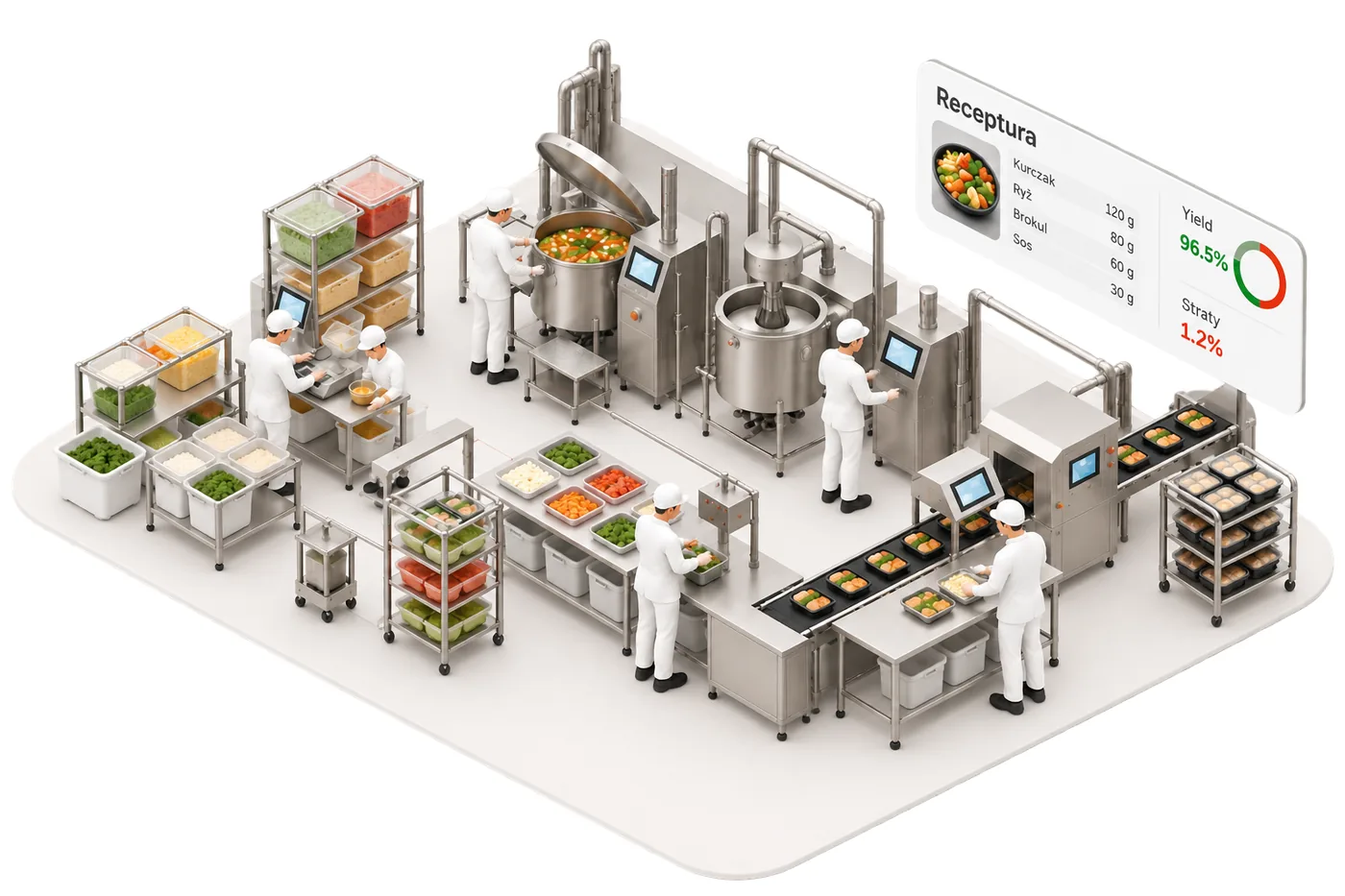
We reproduced the real path of a meal: Raw Material → Preparation → Cooking → Cooling → Portioning → Finished Meal, together with the semi-finished items, yield and losses at each operation.
What we built for Freshweek
Digital recipe carrying ingredients, weights, calories, macros and allergens
Preparation process, semi-finished items, yield, losses, the sequence of operations and the portioning rule
A recipe change flows automatically into food cost, ingredient demand, purchasing and the production plan
The same change carried into portioning and what the customer sees
The key change
One source of truth about the product: the same dish means the same thing in nutrition, in the kitchen, in inventory and in the customer app.
03
Predictive Planning
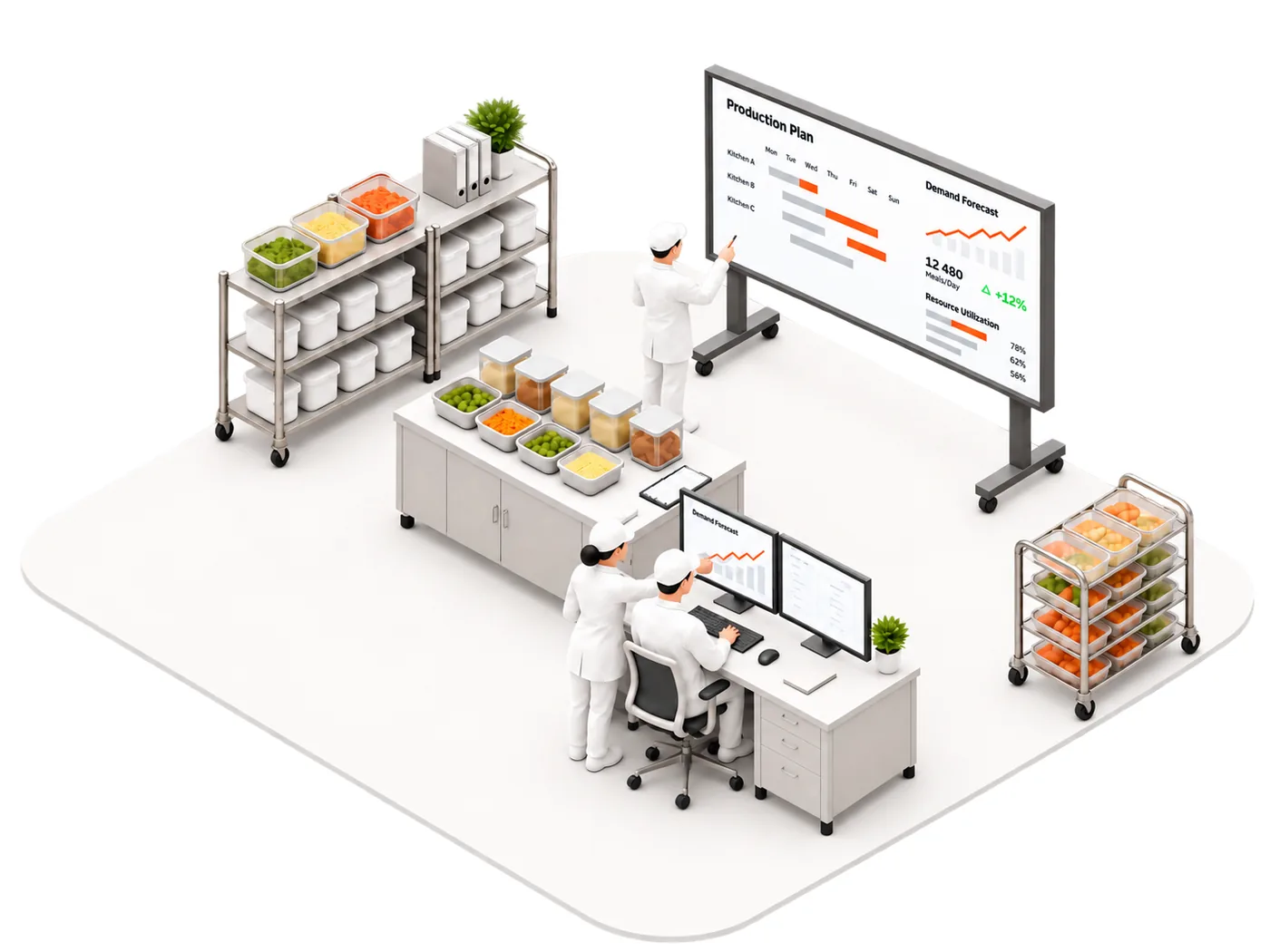
Predictive Layer: How many meals really have to be produced tomorrow?
In meal-plan delivery the order count and the shape of the menu change every day. Knowing the total number of customers is not enough.
Customer Orders
Demand Forecast
SKU Demand
Recipe Explosion
Material Requirements
Production Plan
Schedule
Context
You have to know how many units of a specific dish are needed, in which variants and calorie levels, which semi-finished items have to be made first, when each element has to be ready and which work centers will carry the load.
Problem
Planning only against firm orders means the plant reacts too late: too little time is left for ingredients, people and the schedule.
Analysis and mapping
We built the chain of calculations from customer orders through the recipe explosion to the schedule, so that every element of the plan traces back to real or forecast demand.
What we built for Freshweek
Predictive layer using historical data to forecast demand before the order cut-off
Production, ingredients, resources, people, purchasing and packing prepared earlier
Plan updated as real orders come in
The key change
Planning moves from reacting to firm orders to preparing the plant for the demand it expects.
04
Purchasing
Purchase Engine: Purchasing that follows what Freshweek intends to produce
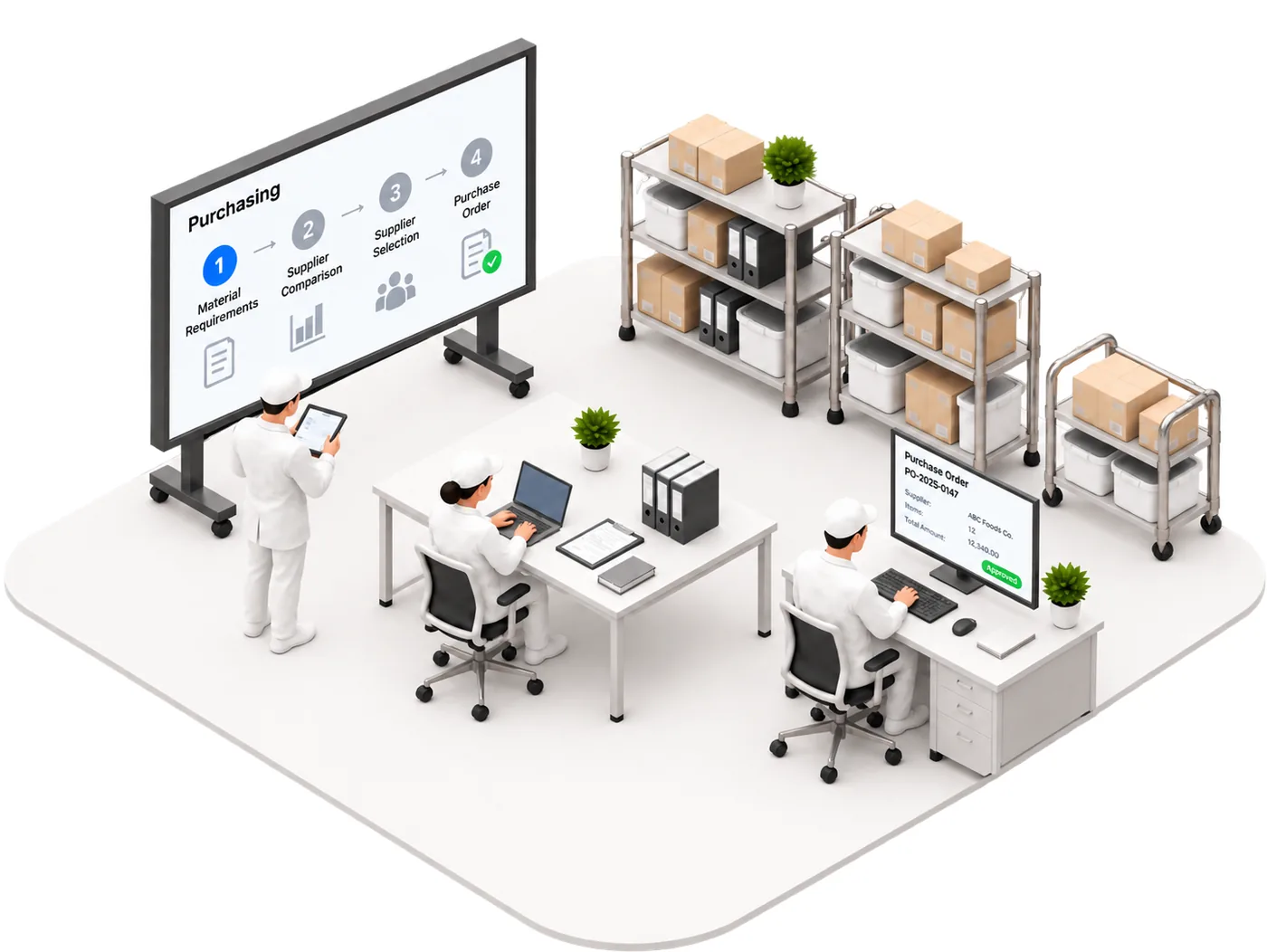
The production plan resolves into material requirements automatically. The buyer no longer works dish by dish.
Production Demand
Recipes
Material Requirement
Current Stock
Purchase Requirement
Context
With a large range of dishes and variants, calculating ingredient requirements by hand is the slowest and riskiest step in supply.
Problem
Without a link between the production plan and purchasing there is no clear answer to what is short, in what quantity and by when, and decisions get made on experience instead of data.
Analysis and mapping
We set the requirement coming out of the recipes and the production plan against current inventory, producing one automatically calculated purchasing list.
What we built for Freshweek
Buyer view: what is short, in what quantity and by when
Which supplier can supply it, at what price and what the alternatives are
The list edited and turned into purchase orders
The key change
Purchasing becomes a direct consequence of real and forecast customer demand.
05
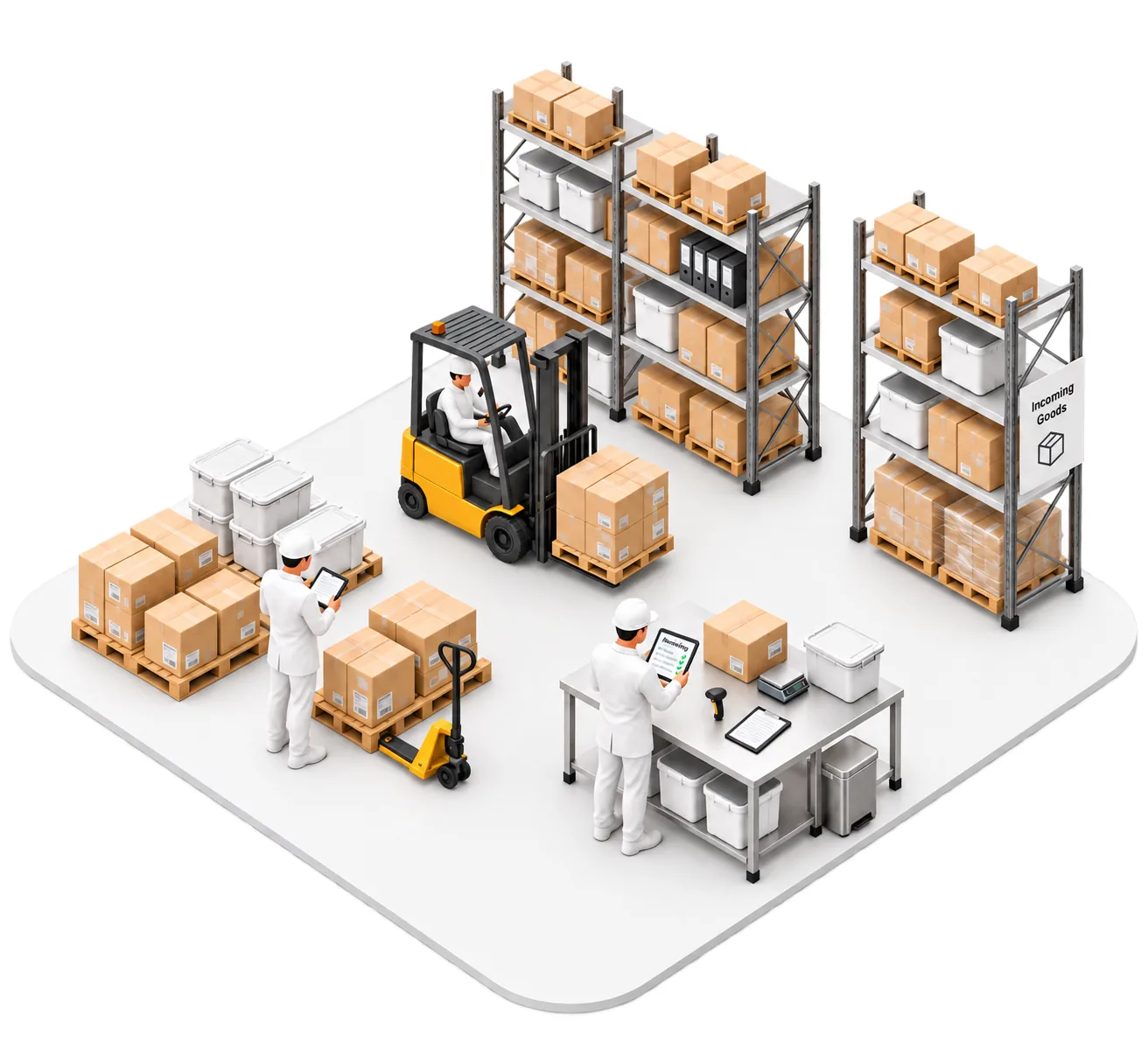
Warehouse & Receiving
Digital Receiving & Inventory: Ingredients on hand exactly when production needs them
An incoming delivery is digitally tied to the purchase order behind it, and once received the product is immediately available to planning and production.
Planned Delivery
Arrival
Verification
Quantity & Quality Check
Lot / Expiry
Inventory
Context
Receiving is the moment where control over ingredient cost, quality and lot traceability is either established or lost.
Problem
When a delivery reaches the system late, inventory stops being trustworthy and planning and production work on stale data.
Analysis and mapping
We put the whole receiving process in order (from the planned delivery through the inventory update to supplier quality data) and only then designed the operational screens.
What we built for Freshweek
Ordered checked against delivered: quantity, price, quality, temperature, lot, expiry date and storage location
Receiving moved into a digital environment, with a full history
Option of a partial receipt or a rejection
The key change
Every ingredient has a known lot, date and location, and production plans against live inventory rather than an estimate.
06
Raw Material Issue & Production
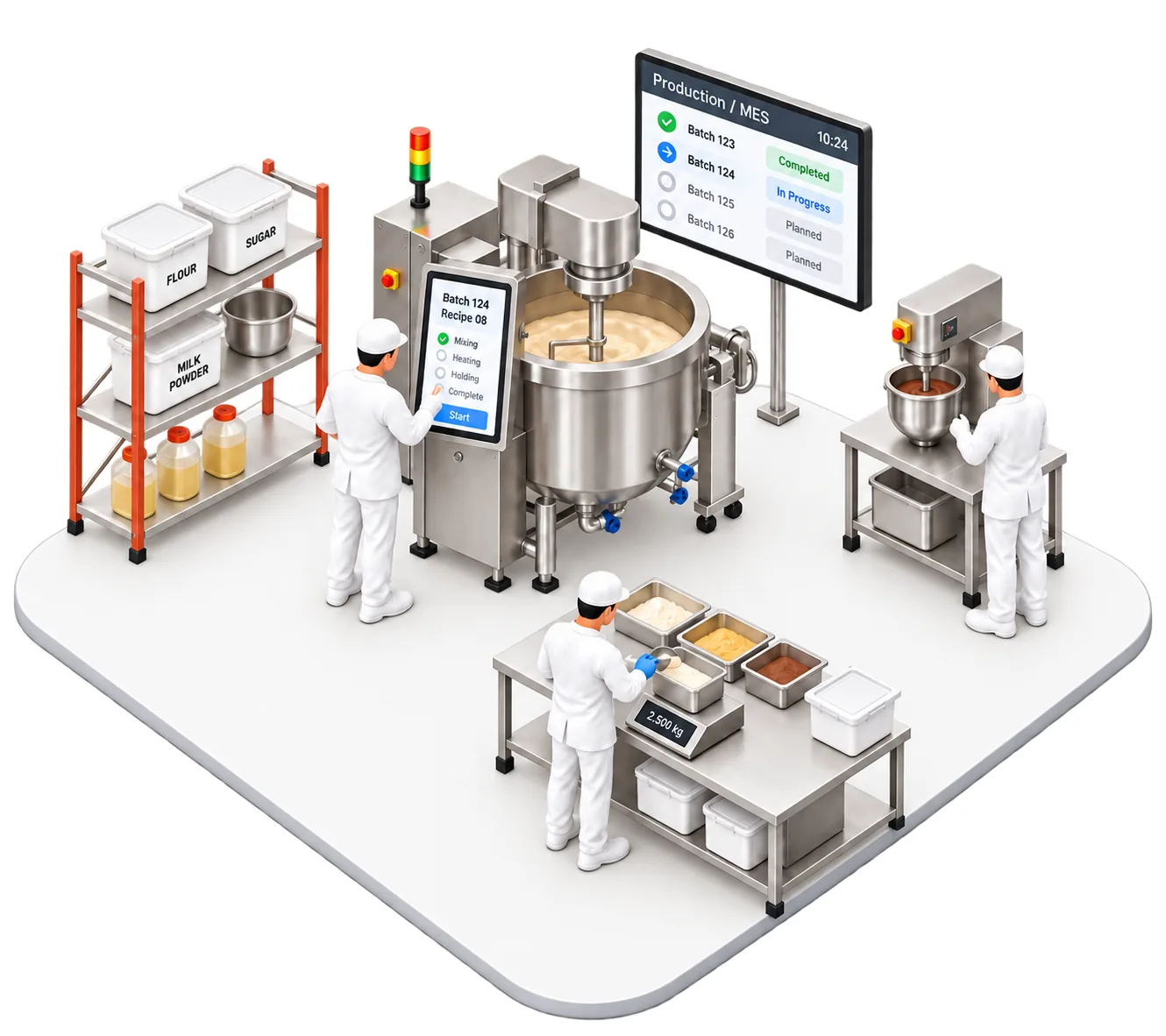
Issue Queue + MES: From the plan to what actually happens on the floor
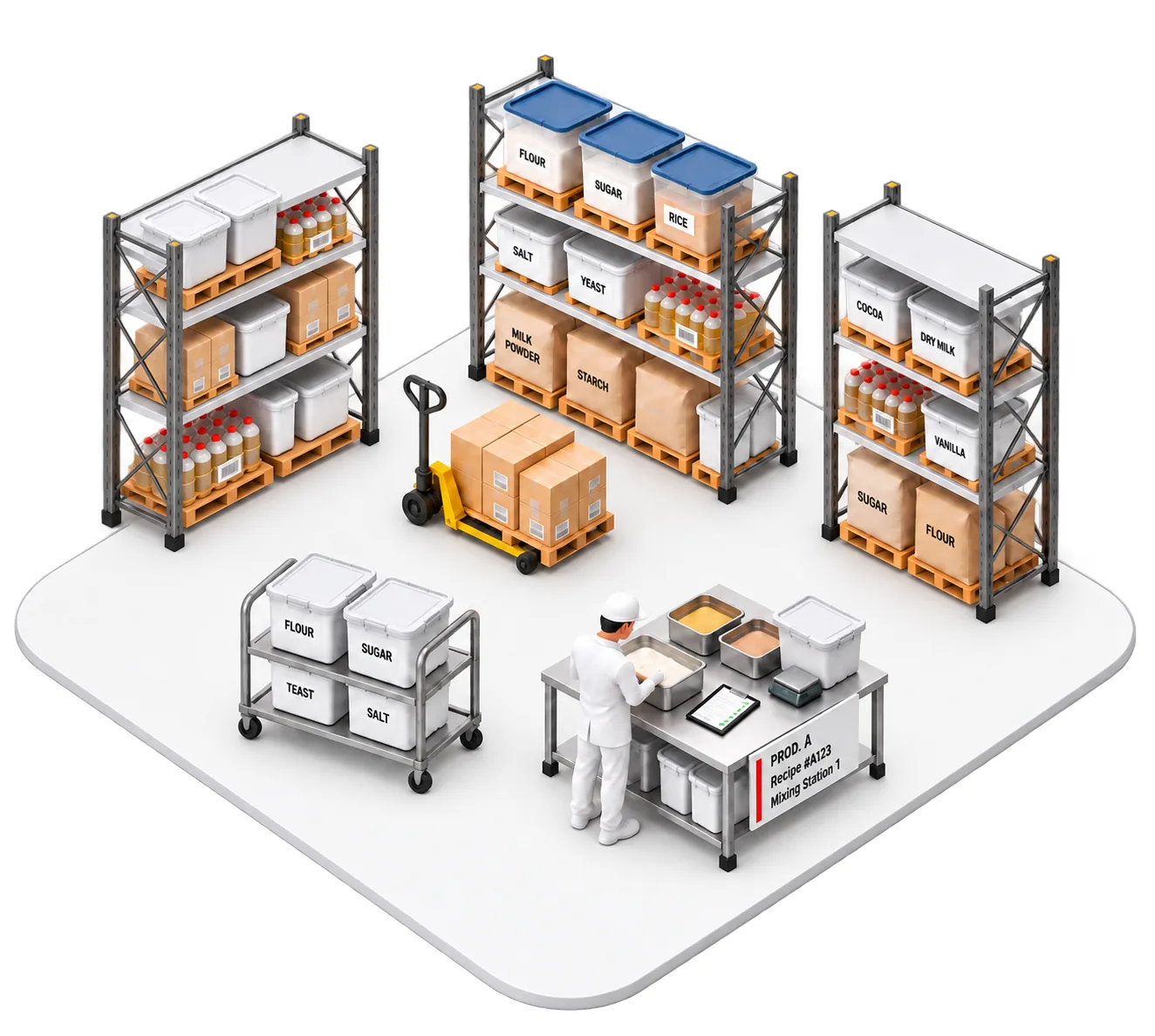
The warehouse does not wait for a phone call from production. In our system we determine in advance which ingredient, in what quantity, for which hour, for which dish and to which work center it has to go.
Material Ready
Prepare
Cook
Measure
Finish
Context
Prep, hot kitchen and cold kitchen run in parallel on the floor, each with its own sequence of operations and its own material requirement.
Problem
Material issued too early takes up floor space, issued too late it stops the kitchen, and execution reported after the fact gives the supervisor no real picture of the day.
Analysis and mapping
We tied the production schedule to a digital issue queue (Production Schedule → Material Queue → Picking → Production Station), and every dish to its recipe, lot, work center, sequence of operations, planned time and expected yield.
What we built for Freshweek
Mobile issue handling for the warehouse operator, every operation tied to an inventory update and a digital trail
Digital instruction handed to the operator on the floor
Recorded in the system: Start → Execution → Time → Weight → Yield → Loss → Finish
Supervisor view: what is waiting, what is running, what is finished, where a delay is building and whether components are ready
The key change
Production moves from a plan plus after-the-fact reports to digital execution monitored in real time.
07
Portioning & Packing
Portioning & Packing Control: Thousands of repeatable portions and the right label
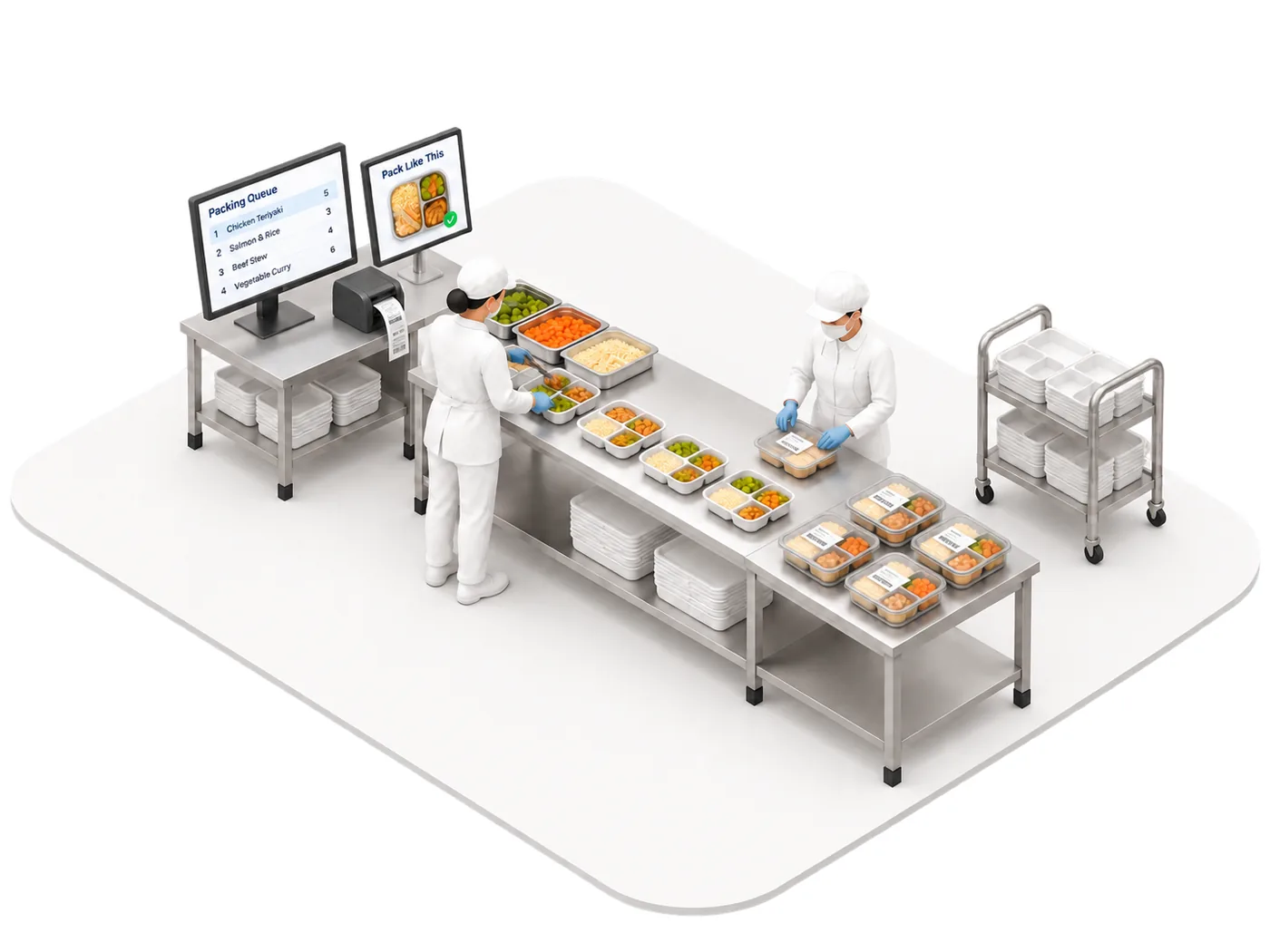
A finished dish has to become the right number of repeatable portions, and then reach the right packaging with the correct label.
Ready Meal
Portion
Pack
Label
Quality Check
Finished Meal
Context
With a large range of variants and calorie levels, repeatable portion weight is what decides product quality and the real food cost.
Problem
Without digital control nobody knows how many portions a lot actually produced, what the weight variance was, or whether the product got the right label.
Analysis and mapping
We connected portioning and packing to the production lot and the recipe, so expected values can be set against actual ones.
What we built for Freshweek
Which dish is being portioned, how many portions are needed and what weight each portion carries
The lot the product belongs to
Expected Portions compared against Actual Portions and Expected Weight against Actual Weight
For packing: packaging type, weight, lot, date, label and the required product information
The key change
Variance and real yield come under control, and every pack is digitally tied to its product and lot.
08
Order Assembly
Order Fulfilment: From a single box to a complete customer order
This is one of the biggest differences between Freshweek and classic food production. Finished meals do not go anonymously into finished goods: they have to be assembled against individual orders.
Packed Meals
Customer Order
Picking
Bag Assembly
Verification
Closed Bag
Context
A sample pick list for customer 12487, Tuesday: Breakfast A, Lunch C, Dinner B, Snack D, Snack Box 03.
Problem
An assembly error only shows up at the customer. A missing or swapped meal is not a production problem. It is a customer-experience problem.
Analysis and mapping
We turned the customer order into a digital pick list tied to a specific day, customer and bag.
What we built for Freshweek
The operator assembles every product assigned to a customer
Completeness of the order, the right day and the right customer checked
Product count, extra items and the assignment to a specific bag checked
The key change
From producing individual SKUs to a complete, individual order ready to deliver.
09
Dispatch, Delivery & Data
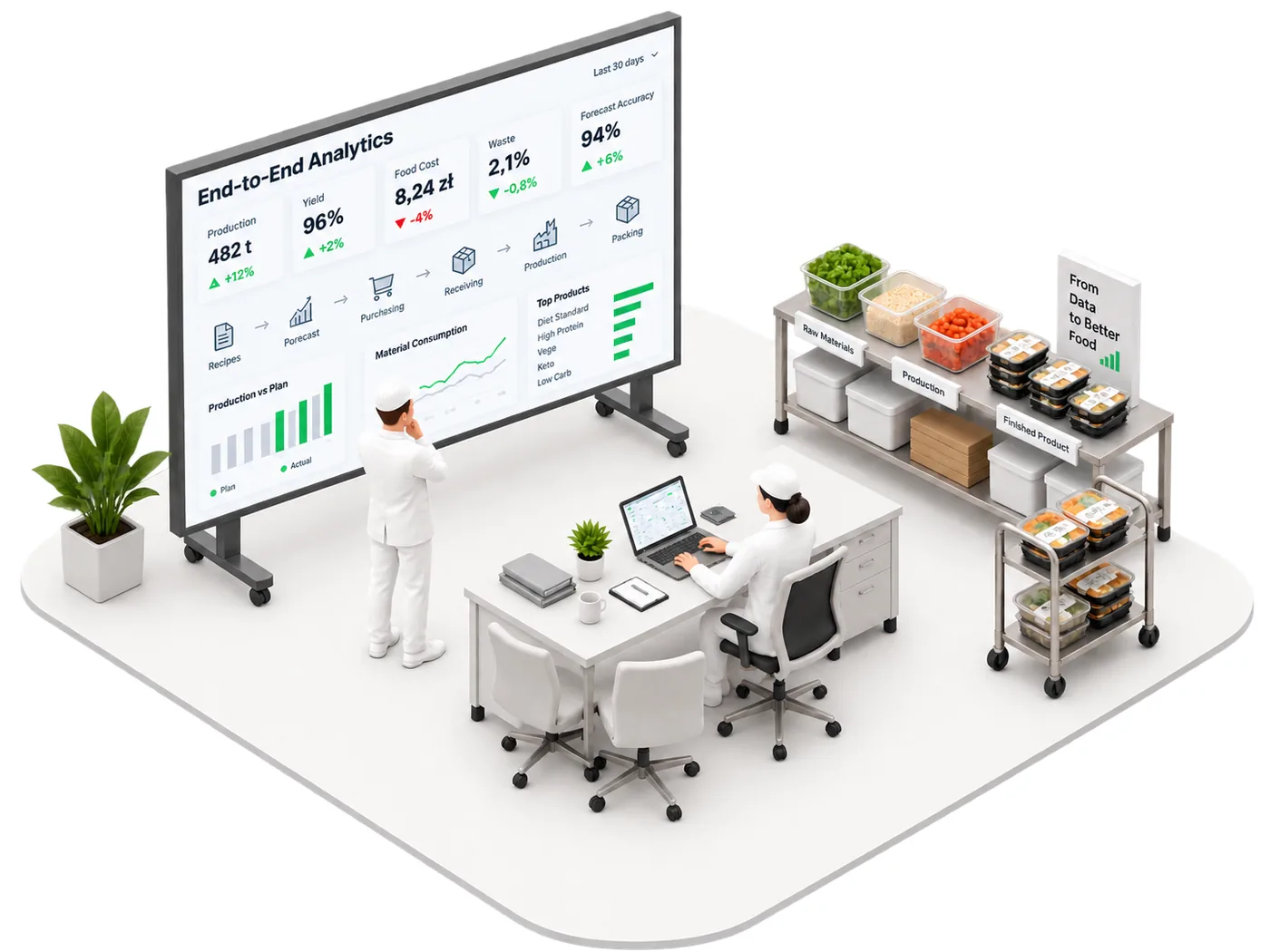
Logistics + Analytics: The right bag at the right door, and data returning to the plan
Freshweek does not deliver a large number of meals to one hospital; it serves a very large number of individual delivery points. That is why production has to be connected to the customer, the address, the bag and the route.
Finished Bag
Dispatch
Route
Refrigerated Transport
Customer Door
Context
The final operational product is not a box of food but a correctly assembled order delivered to the right customer on the right day.
Problem
Without a shared data layer each stage only answers its own local questions, and nobody can see where the losses, delays and errors really come from.
Analysis and mapping
We connected the data across the whole chain: Customer Demand → Recipe → Purchase → Inventory → Production → Packing → Bag → Delivery.
What we built for Freshweek
A bag assigned to its recipient, address, day, area and route
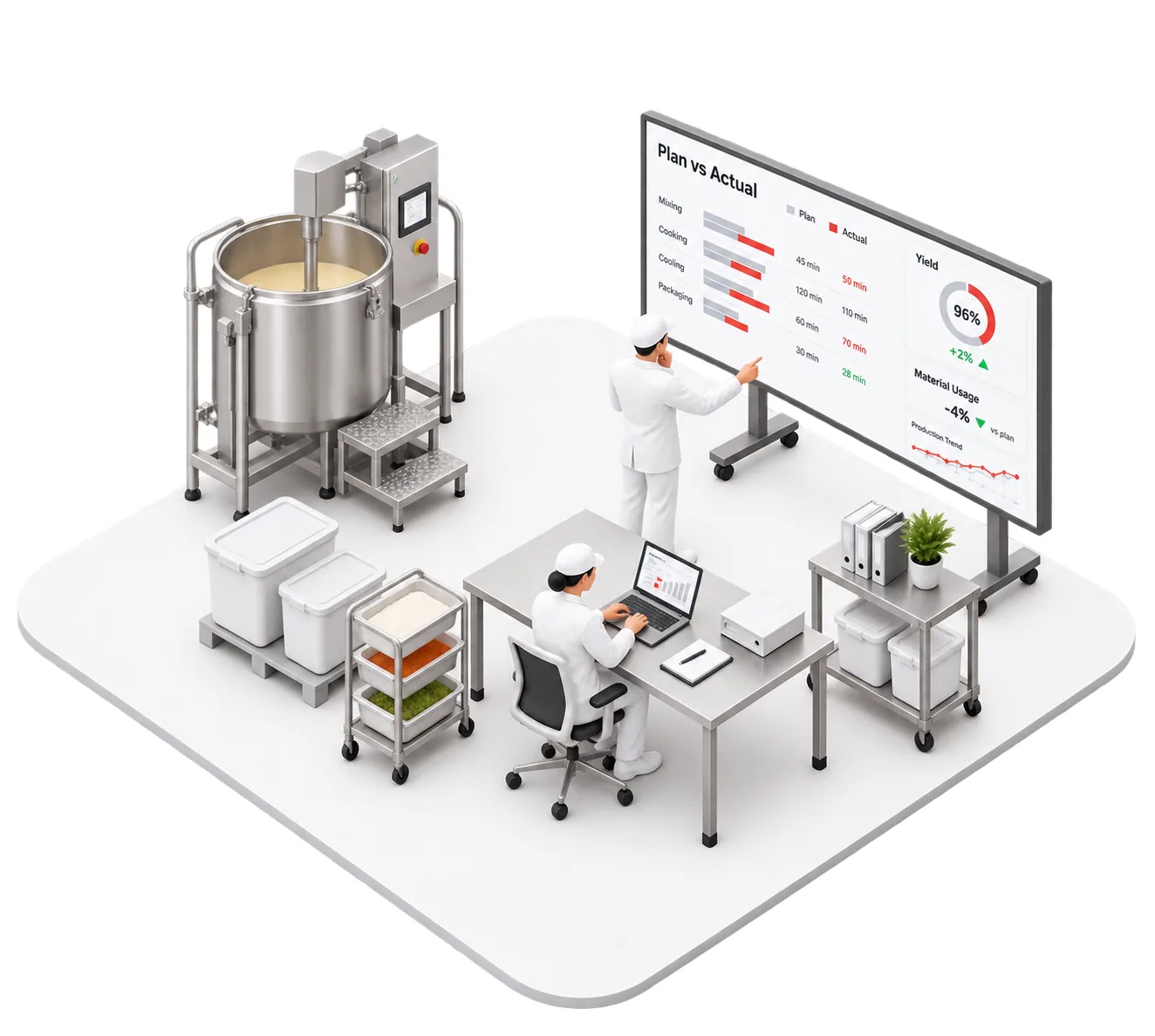
Analytics layer tracking forecast against actual, food cost and real ingredient consumption
Yield, losses, production times and work-center throughput
Order completeness, packing throughput, assembly errors and forecast accuracy
The key change
Actuals feed the next plan: every day of production improves the one after it.
The Connected Flow
Connected Food Operations System
We created the greatest value not in any single module but by connecting the whole process. A change to a customer order moves demand, demand moves the production plan, the plan moves ingredients and purchasing, and we route actuals back into planning.
Customer demand
01Customer
02Order
03Demand
04Recipes
05Production Plan
Supply
06Material Requirements
07Purchasing
08Receiving
09Warehouse
Production
10Raw Material Issue
11Production
12Portioning
13Packing
Assembly and delivery
14Order Assembly
15Dispatch
16Delivery
17Data & Analytics
Learning loop
18Better Planning
Data from production, packing and delivery returns to the forecast and sharpens the next planning cycle.
Project outcomes
Eight shiftsthat define the project
Before
After
Customer orders as a separate e-commerce world
Customer demand connected directly to production demand
A recipe as a list of ingredients
A recipe as a digital model of the process, yield and cost
Planning that starts after the order cut-off
Forecast demand and a plant prepared in advance
Purchasing calculated by hand, dish by dish
Purchase requirements calculated from the plan and inventory
Deliveries and inventory updated late
Digital receiving with lot, expiry date and live inventory
Production reported after the fact
Digital execution recording time, weight, yield and losses
Producing individual SKUs
A complete, individual customer order in one bag
Data locked inside single stages
One data layer from demand to delivery and back to the forecast
Note
At this stage the outcomes are described qualitatively. Specific figures and KPIs will be added once Freshweek confirms the data.
Connect customer demand to production and delivery.
It starts with analyzing and mapping your processes, exactly as it did at Freshweek.